Overview
Trackoon is a conceptual browser extension designed to help users better understand and manage cookies and user agreements online.
The project focuses on IT security with a specific emphasis on personal privacy. Today, users are often required to accept long and complex legal texts without fully understanding what they agree to.
Our goal was to create a tool that simplifies this information and makes it accessible to everyone — regardless of prior knowledge.
Research Questions
How do users experience online privacy and security today?
How do users interact with long and complex terms & conditions?
What would help users feel safer and more in control online?
Target Group
The target group includes adults aged 18–65 in the EU with limited knowledge of digital privacy and data security.
We intentionally chose a broad audience to ensure inclusivity and to design a solution that works for a wide range of users.
Process & Role
This was a collaborative group project with flexible roles. My main responsibility was as Content & Interaction Design Lead.
I focused on:
Structuring and simplifying complex information
Designing user flows and interactions
Ensuring clarity and usability in the interface
Research
We conducted a mixed-method research process:
Focus group (4 participants)
Survey (68 responses)
Workshop (6 participants, 2 hours)
User testing (5 participants)
We also performed thematic and statistical analysis using FigJam, Microsoft Forms, and Excel.
Workshop Insight
In the workshop, we simulated real-world consent behavior by asking participants to sign long and complex terms under time pressure.
Later, we revealed hidden clauses in the text to provoke discussion around informed consent.
This helped us understand:
Users often accept without reading
Stress and time pressure affect decisions
Trust and clarity are critical
Key Insights
Users do not understand terms and conditions
Legal texts are too complex and overwhelming
Many users automatically accept cookies for convenience
There is a lack of knowledge about privacy and rights
Users want more control and transparency
Needs vary greatly between individuals
One important finding was that 75% of users were interested in using a tool to better understand how their data is handled.
Solution
Based on our findings, we designed Trackoon as a browser extension that:
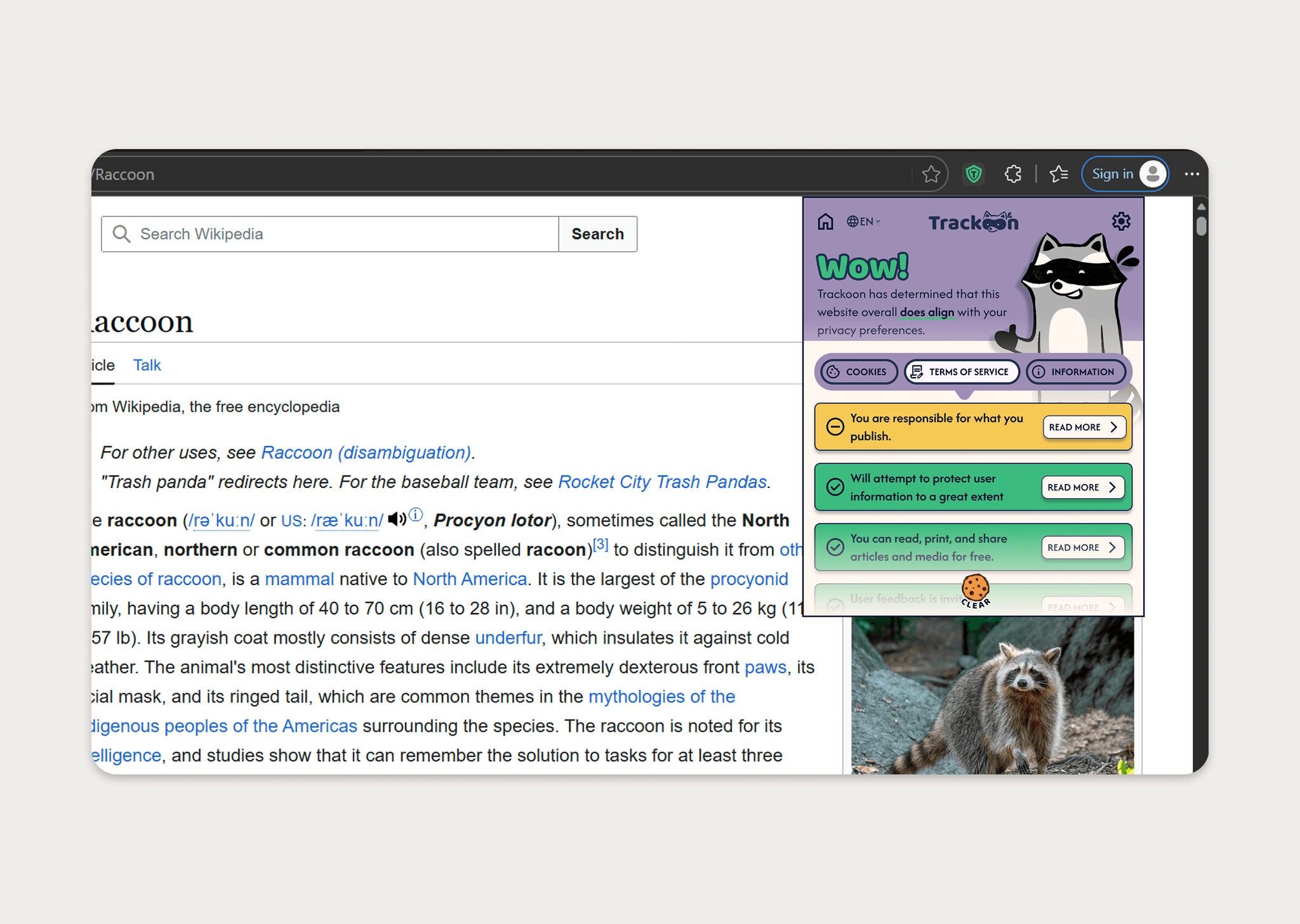
Summarizes terms and conditions in simple language
Highlights key information first
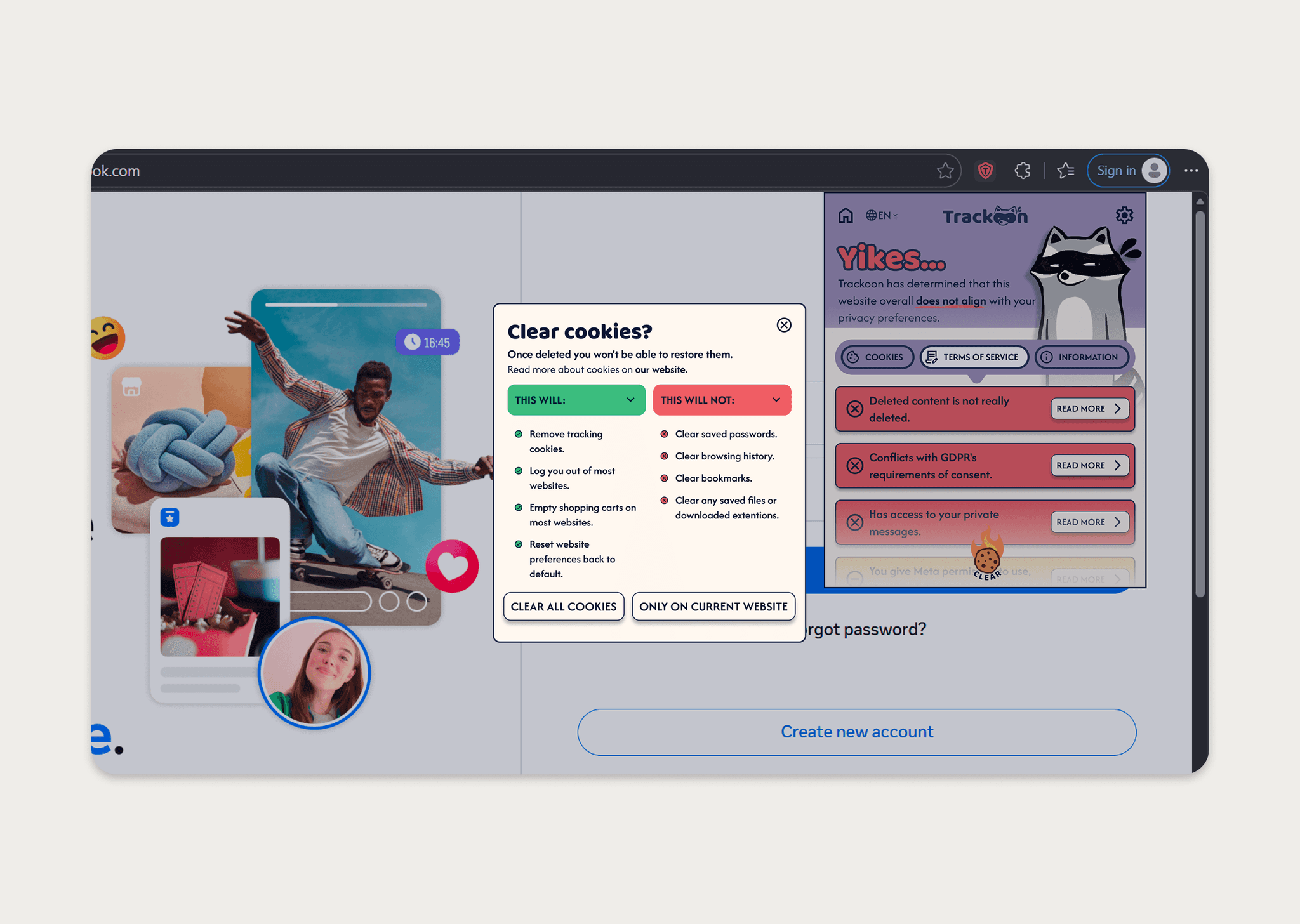
Allows users to explore details if needed ("Read more")
Provides transparency about data usage
Includes features like "Clear Cookies"
Adapts to user preferences
The tool also includes a visual mascot to guide users and create a more engaging experience.
User Testing
We tested the prototype with 5 users using think-aloud methods and A/B testing.
Key improvements included:
Clearer button design
Reduced text and better summarization
Improved visibility of key actions
Better indication of privacy alignment with user preferences
Reflection
We identified that more time for research and deeper technical understanding could have improved the project further.
However, the project clearly demonstrated that there is a strong need for tools that make privacy understandable and accessible.
Trackoon aims to bridge the gap between complex legal systems and everyday users by turning passive consent into informed decisions.